We scanned 102 home care web pages across Bedfordshire, Cambridgeshire, Hertfordshire and their neighbours, then asked Gemini, ChatGPT, Claude and Perplexity the questions a family asks. Most of these businesses are well built for search. Most of them are absent from the answer.
This is the first published benchmark from our AI Visibility plugin‘s bulk mode: a whole regulated market, measured the same way on the same day, with every figure traceable to the scan that produced it. It is also the sector-wide version of a result we published about ourselves first: a site can score 96, 100 and 100 and still not be the answer.
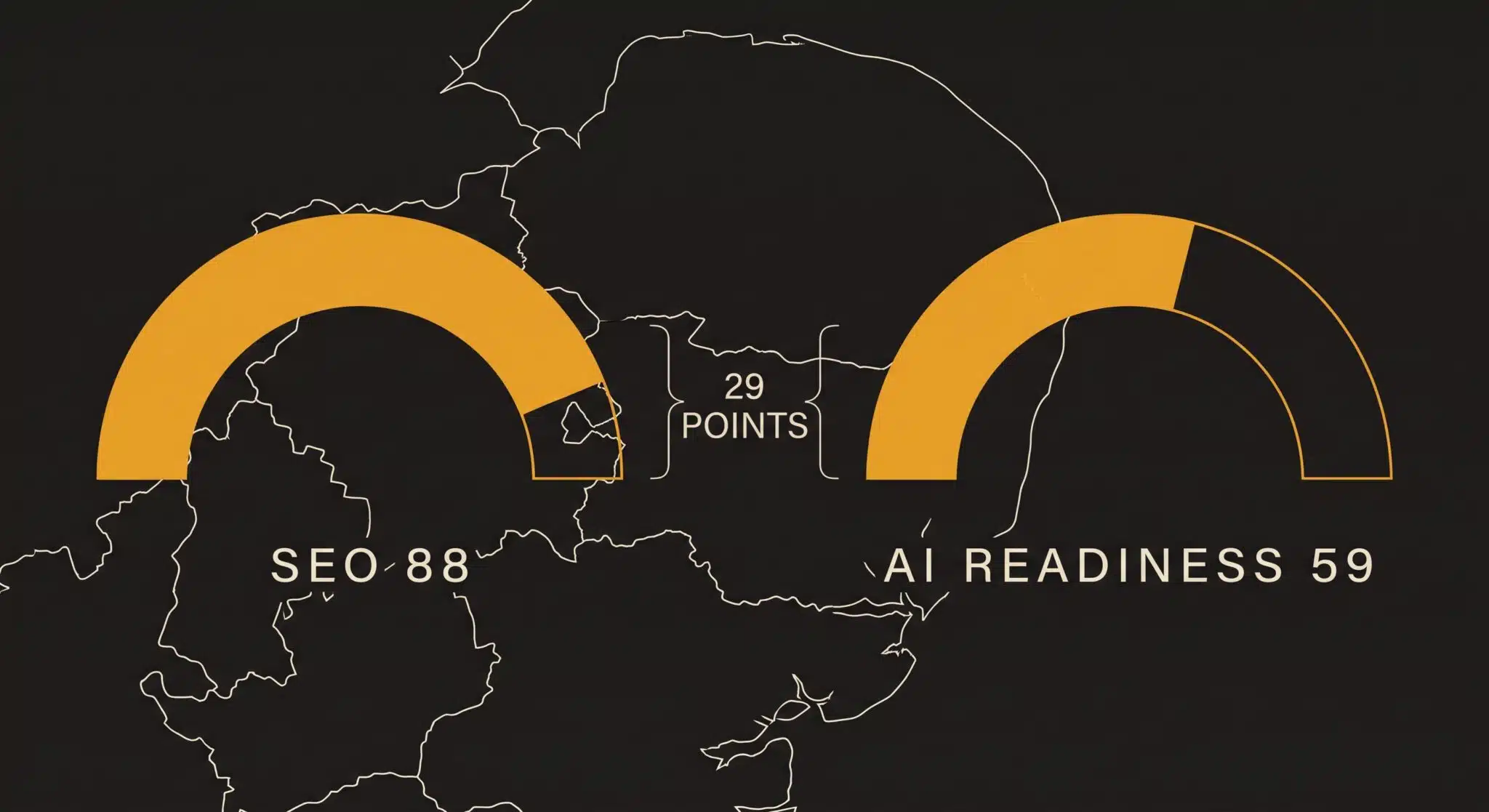
The numbers in one place
| Measure | Result |
|---|---|
| Pages scanned (12 August 2026) | 102, belonging to 66 distinct provider websites |
| Median SEO score | 88 / 100 (lowest 43, highest 99) |
| Median AI Readiness score | 59 / 100 (lowest 28, highest 87) |
| Median GEO score | 57 / 100 (lowest 25, highest 80) |
| Areas put to the assistants | 10 — 200 requests, 170 answers |
| Providers named at least once, in any area | 26 of 66 (39%) |
| Providers never named in any area | 40 of 66 (61%) |
| Providers named in their own area (of those we could place) | 12 of 26 (46%) |
| Share of all namings taken by six national networks | 61% |
| Answers that sent the family to homecare.co.uk | 82 of 170 (48%) |
Batch 20260812-223433-440c59. Scans 12 August 2026; assistants asked 30 August 2026.
Why we ran this
Home care is a regulated market with a public register, an inspection regime and, in most families, a moment of urgency. Increasingly the first question is not typed into Google. It is asked of an assistant — who provides home care in Bedford? — and the assistant answers with a handful of names. Whether a provider is in that handful shows up in no analytics dashboard, no search console and no ranking report. It is only visible by asking the assistants directly, per place, and checking who they name.
That is what the citation check in our plugin does, and why it works the way it does. A buyer asks about a place, not a business, so we ask each question once per area and check every provider in the benchmark against the answer — full coverage rather than a sample, and the same competition a family’s question creates. We explained the reasoning behind measuring citations rather than rankings in Is AI recommending your business? Now you can measure it and in our note on measuring GEO honestly. This study applies that method to a whole sector.
Finding 1 — A 29-point gap between search readiness and AI readiness
These are, on the whole, well-optimised websites. The median SEO score is 88 and only two pages sit at or below 45. The median AI Readiness score — how reliably an assistant can crawl, read, understand and quote the site — is 59, and seven pages sit at or below 45, the band at which a site is largely unreadable to an assistant whatever its rankings say.
The gap has concrete causes. Across the 102 pages, an llms.txt file is present on 14; a sitemap is missing on 16; one site allows only 12 of the 20 AI crawlers we test. Eighteen of the 66 websites score 80 or more for SEO while scoring under 60 for AI Readiness: built to rank, not built to be read. We set out what the two disciplines actually share and where they part in What GEO actually means.

Finding 2 — 40 of the 66 providers are never named
We put ten areas to the four assistants: nine counties and one district. Each area was asked five buyer questions per assistant — twenty requests — and every provider in the benchmark was checked against the answers by website and by name. Across the ten areas, 26 of the 66 providers were named at least once. 40 were never named, in any area, by any assistant.
| Area | Level | Answers received | Providers named |
|---|---|---|---|
| Bedfordshire | county | 17 of 20 | 5 of the 7 placed there |
| Buckinghamshire | county | 17 of 20 | 2 of the 4 placed there |
| Cambridgeshire | county | 17 of 20 | 4 of the 8 placed there |
| Essex | county | 17 of 20 | 0 of the 1 placed there |
| Hertfordshire | county | 17 of 20 | 6 of the 13 placed there |
| Huntingdonshire | district | 17 of 20 | 4 of 66 in the benchmark |
| Lincolnshire | county | 17 of 20 | 6 of 66 in the benchmark |
| Norfolk | county | 17 of 20 | 4 of 66 in the benchmark |
| Northamptonshire | county | 17 of 20 | 7 of 66 in the benchmark |
| Suffolk | county | 17 of 20 | 1 of the 1 placed there |
“Placed there” means the provider’s own area is known from evidence on its site; those rows answer the question a family in that county would ask. For the other areas the figure is how many of all 66 benchmark providers appeared in that area’s answers.
The names are concentrated. Six national networks — Bluebird Care, Home Instead, Visiting Angels, Right at Home, Helping Hands and Caremark — were each named in six to nine of the ten areas, and between them account for 61% of every naming in the study. Of the 26 providers named at all, twelve were named in exactly one area and seven in two. Scored against their own area, the question a family in their town would actually ask, 12 of the 26 providers we could place were named.

Finding 3 — Being well built is not the same as being recommended
This is the result that matters most, and it is the same one our own audit produced. Ten of the 66 websites score 70 or more for AI Readiness. Six of those ten were never named. At the other end, 16 websites score under 50, and four of them were named — one of them, a national network’s site scoring 49, in nine of the ten areas.
Across the whole benchmark the providers that were named have a median AI Readiness of 60 against 54.5 for those never named, and an identical median GEO score of 57. The measure that separates the two groups most is not AI readiness at all: it is SEO (a median of 92 against 80). Technical readiness on the provider’s own site is necessary — an unreadable site cannot be quoted — but it is not what puts a name in the answer. What does is being present, consistently, in what the assistants retrieve and trust when they search: the directories, the registers and the national brand pages. We set out why assistants resolve a business against independent records rather than its own schema in Entity Resolution: why Wikidata decides if AI trusts you.
Finding 4 — Where the assistants send families instead
Because the answers are checked for websites and not only for our benchmark providers, the study also records who the assistants named instead. The list is short and the same in every county.
| Website recommended in the answers | Answers naming it (of 170) |
|---|---|
| homecare.co.uk | 82 (48%) |
| trustedcare.co.uk | 52 (31%) |
| caresourcer.com | 43 (25%) |
| thegoodcaregroup.com | 28 (16%) |
| care.com | 27 (16%) |
| homeinstead.com | 18 (11%) |
Websites outside the benchmark that appeared in the assistants’ answers or in the sources they read, by number of answers.
In practice the assistants answer a county-level home care question in two moves: name the national networks they already know, then send the family to a directory to find the rest. A local provider that is absent from those directories, or listed on them inconsistently, is absent from the answer even if its own website is excellent. The intermediaries have become the retrieval layer for the sector.

What this means if you run a care service
1. Fix the floor: make the site readable before anything else
An llms.txt, a working sitemap, every AI crawler allowed, and a citable summary with explicit entity data are the difference between a site an assistant can quote and one it cannot. Eighty-eight of these 102 pages have no llms.txt, sixteen have no sitemap, and not one has an ai.txt. This is inexpensive and mechanical; it is what our fixed-price AI Visibility Packages do, and what the free edition of the plugin will tell you is missing.
2. Be present where the assistants read
The name, address, registration and service areas on your CQC entry, your Companies House record, and your directory profiles must agree with each other and with your site. The assistants resolve who you are against those records before they decide whether to name you. That is the substance of Generative Engine Optimisation as we practise it: entity work first, content second.
3. Measure per area, not once
A family asks about a town or a county. Your visibility is a different number in each, and this study’s own-area figures show why it must be measured that way. Ask the questions for your areas, quarterly, and keep the answers: a dated, per-area record is the only honest baseline for any work you commission.
What this means for the sector
When an assistant names the same six networks in every county and sends the rest of the enquiry to a directory, family choice narrows to whoever is retrievable. The inspection rating of a provider that is never named plays no part in the answer. That is a governance question as much as a marketing one, and it is measurable now. We work with regulated providers on exactly this under our Clinical AI Governance service, and we will re-run this benchmark so that the numbers can be tracked over time rather than argued about.
How we measured
The scans. 104 web pages were queued from a list of home care providers operating in Bedfordshire, Cambridgeshire, Hertfordshire and neighbouring counties, and scanned on 12 August 2026 with the bulk mode of the Daryo89 Multi Scan & AI Assessment plugin (M edition). Two link-shortener pages were excluded by hand, leaving 102. Each scan scores AI Readiness, GEO and SEO out of 100 and records the crawler, file and structured-data checks behind them. Branches of one network share a website, so 102 pages resolve to 66 distinct provider websites.
The citation check. On 30 August 2026, ten areas were each put to Gemini (gemini-2.5-flash), ChatGPT (gpt-4.1-mini), Claude (claude-haiku-4-5-20251001) and Perplexity (sonar) as five buyer questions about “home care”, live, with web search on — 200 requests in all. Every provider in the benchmark was then checked against each answer by website and by name using a deterministic text match; no model was asked to judge the answers. The websites the assistants recommended instead were collected the same way, from the answer text and from the sources each assistant read.
The rules. A request that returned no answer is left out of every denominator: 170 of the 200 did. An area with no answers would be listed as not measured and counted nowhere; none was. “Named in its own area” is reported only for the 26 providers whose area could be established from evidence on their own site; the other 40 are not extrapolated. Every ratio in this article is published with both of its halves.
What this study does not show
- It is a snapshot. Assistants change their answers; the model versions and the dates are given so that it can be repeated.
- It measures whether a provider is named, not where in the answer, how favourably, or whether the assistant’s description of it was accurate.
- A national network is matched by its website, so “named in Bedfordshire” means the brand was named, not necessarily the Bedford branch.
- Ten areas at county and district level were asked. Town-level questions — home care in Huntingdon rather than in Huntingdonshire — are the next pass, and may change individual results.
- Thirty of 200 requests returned no answer. They were excluded, not counted as a miss.
Reproduce it, or run it for your own area
The scanner is a WordPress plugin. The free edition scores your own site with nothing to configure. The Client edition adds the live citation test for a single site; the Agency and M editions run whole benchmarks like this one and produce the white-label report. If you would rather we measured your area and explained the result, talk to us.
Data and citation
The evidence file for this benchmark — one row per area per assistant, per provider per area, per website recommended instead, and per answer received, each carrying the model, the timestamp and the plugin version — is available to journalists and researchers on request, as is each provider’s own result to that provider. Individual independent providers are deliberately not named in this article.
Cite as: Daryo89 Ltd, “East of England Home Care AI Visibility Benchmark”, 30 August 2026, batch 20260812-223433-440c59, daryo89.com.
Frequently asked questions
What does “named” mean in this study?
That the provider’s website address or business name appeared in the text of an assistant’s answer to a home care question about a specific area. The match is a deterministic text comparison; no AI model judged the answers.
Why ask once per area rather than once per provider?
Because a family asks about a place. A category question is not about any one business; asking it separately for forty providers in one county would pay forty times for one answer. Asking once per area and checking every provider against it gives full coverage and mirrors the competition the real question creates.
Does a high AI Readiness score guarantee being recommended?
No. Six of the ten best-scoring websites in this benchmark were never named. Readiness makes a site quotable; being named depends on being present and consistent in the records and directories the assistants retrieve.
Can my provider see its own result?
Yes. Any provider in the benchmark can request its own per-area result, and any provider can run the same scan on its own site with the free plugin.