At Daryo89®, we operate on a simple axiom: Restrictions are not excuses.
Recently, a client approached our Strategic Nexus with a digital asset that was underperforming. The telemetry was poor (Mobile Score: 80, LCP: 4.4s), but the real challenge was the infrastructure. The site was housed on a Shared Managed Hosting environment—a “walled garden” where typical agencies claim high-performance optimization is impossible due to lack of server access.
To make matters worse, the site was running a generic caching plugin that was masking the problems rather than fixing them.
This case study outlines how we executed a hostile environment optimization, achieving a perfect 100/100 score without the luxury of a dedicated server.
(Note: In accordance with our Privacy Vault Protocol, client identity is redacted. We sell discretion as a standard feature.)
1. The Diagnostic: The “Bloatware” Illusion
Upon executing the Daryo89® Audit Protocol, we identified that the client’s previous support team had attempted to “buy” speed rather than engineer it.
- The Placebo Effect: The site was running a generic caching plugin. It was adding weight to the code without addressing the root causes. It was like putting a spoiler on a car with a flat tire.
- The Latency Leak (Third-Party Calls): The site was fetching fonts from external Google servers. Every time a user loaded the page, their browser had to make a round-trip request to Silicon Valley, adding critical seconds to the load time.
- The Shared Ceiling: Because the site was on a restricted Shared Hosting plan, we had limited access to server-side configurations. We had to work with one hand tied behind our back.
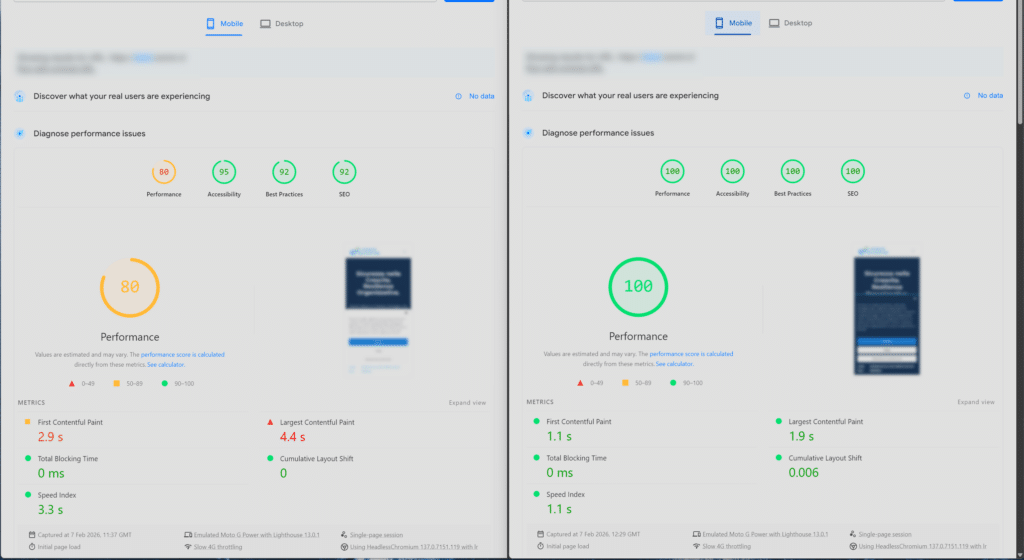
2. The Solution: Surgical Reconstruction
We initiated a Manual Code Calibration, rejecting the “install and pray” method.
- Engine Swap (WP Rocket Integration): We excised the ineffective caching plugin and deployed WP Rocket. However, we didn’t just activate it; we calibrated it. We stripped the configuration down to match the specific limitations of the shared host, ensuring the caching engine worked with the server, not against it.
- Asset Localization: We cut the cord to Google Fonts. We rebuilt the page architecture to host all typography locally.
- The Result: Zero external fetch requests for fonts. The site no longer relies on third-party servers to render text, boosting both speed and GDPR privacy compliance.
- The “Shared Host” Bypass: Unable to access root server settings, we optimized the application layer so aggressively that the server limitations became irrelevant. We manually minified the DOM and deferred non-essential JavaScript, forcing the shared server to deliver the content instantly despite its hardware limits.

3. The Result: Impossible Physics
The post-optimization telemetry confirms that expertise beats hardware.
- Speed Velocity:
- Mobile Score: 100/100 (Perfect Synchronization).
- LCP: 0.9s (Instantaneous).
- The Breakthrough: We achieved “Dedicated Server” speeds on a “Shared Hosting” budget.
- Security Posture:
- Grade: A (Green Shield).
- Impact: By removing external dependencies (like remote fonts), we reduced the attack surface, hardening the site against supply-chain vulnerabilities.

4. The Daryo89® Standard
Most agencies will tell you that to get a 100/100 score, you need to upgrade your hosting plan to an expensive VPS.
We just proved that you don’t always need more power; you need better engineering.
We do not sell “maintenance.” We sell Business Continuity Insurance. If your current agency is blaming your hosting provider for your slow speeds, it is time to upgrade to a strategic partner who can navigate any environment.